Showing posts with label lifestyle in ahmedabad. Show all posts

Monday, April 9, 2012

Zucchini is now getting popular in Ahmedabad


Recently, I saw zucchini at a newly opened mall and a few days later, also had some in a soup, a salad and pasta at a restaurant. Zucchini appears to be getting popular in Ahmedabad. As far as appearances go, green or yellow, it looks like cucumber and is like a mix between doodhi and cucumber, as it is white from within, yet the taste is different and not easy to define. It is also not easy to find, as it is available at a few speciality vegetable shops. Zucchini is often added to salad and pastas. It also makes excellent bondas, when cut into roundels, dipped into a spiced chana ata mixture and deep fried.


These bondas used to be available at a well known restaurant, but no longer so. A dear friend in Vadodara grows giant zucchinis on her farm and serves an incredible salad of zucchini with lettuce, red, green and yellow bell peppers, all soaked in a delightful olive oil dressing. If she does not make a salad of the same, she makes it into a stir fried vegetable with the addition of mushrooms, carrots, baby corn, spring onions with salt plus pepper and a dash of Soya sauce. The best part about zucchini is that, it does not need to be cooked for long, as it gets done in a jiffy and can be also eaten raw or even made into a curry with brinjals and tomatoes.

One can also make it into a mouth watering baked dish, with cheese. Zucchini can be very addictive once you get used to its rather bland but different taste. Recently, I met my American friend Joanne over coffee and she told me how she had tried to make zucchini bread. All you need to make zucchini bread is flour, oil, eggs, salt, sugar, vanilla, baking flour, cinnamon powder, crushed walnuts if you want a crunchy bread and of course, zucchini, grated or chopped or shredded. Beat eggs till light and fluffy, add oil, sugar and vanilla, add zucchini and mix well, add nuts, grease a loaf pan, pour the mixture and bake till done. 

The appearance of zucchini at some shops and many restaurants in Ahmedabad, is the perfect example as to how eating habits are changing in Gujarat.

Tuesday, April 3, 2012

Sight Scenes


Other cities like Delhi, Lucknow, Jaipur and Amritsar had emulated Ahmedabad's Heritage walk. The old city, known as the walled city is a congested place. There are narrow pols(streets) and heavy traffic round the clock. Ahmedabad Municipal Corporation's Heritage Cell organizes Heritage Walk programme since 1997. With active participation in the same, one can experience the old era of city.

Heritage Walk

Some world famous Islamic architectures, unique Hindu and Jain temples, big mansions with rich woodwork, the construction of pols and the lifestyle of the people livingin those pols are the peculiarities of this city. it is necessary to take up Heritage Walk to watch the architecture, art, religious places, culture and tradition of the walled city.
To start with the same, you need to reach kalupur Swaminarayan temple at eight o'clock in the morning.
  • A trip of 1.5 kms
  • Two and half hour duration
  • Participation Fee - Indian Rs.20/-, Foreigners Rs.50/-
  • Photography allowed
  • Open on all days.
    Office : Ph.: (079) 32984116
    Chandrashekhar: 9327021686.

Tourist Information Center

AMC - Tourism Desk
Law Garden, Ahmedabad - 6
Ph.: (079)32520378

AMTS - Tourist Bus Services

Ahmedabad Municipal Transport Service (AMTS) has made a special arrangement for tourist to visit historical and other well known places in Ahmedabad. This bus service is available from Lal Darwaja.
The Timings of the service:
9:00am to 1:00pm, 1:30pm to 5:00pm
Ticket: Rs. 60 per person. Non A/c Coach.

Ahmedabad City Sights

You can enjoy comfortable air-conditioned city tour with professional tour guide. Pick-up point is opposite to Gandhi Ashram. The tour is not operated on Monday afternoon. There are some changes in route of morning and afternoon tour.
Charge ScheduleMorningAfternoon
AdultRs. 200/-Rs. 225/-
StudentRs. 180/-Rs. 225/-
ChildRs. 130/-Rs. 175/-

Travel where you like - A scheme by AMTS

Adults as well as children can travel by municipal bus wherever they like from 6:00am to 10:00pm. The ticket charges : for adults Rs. 20/-and for children Rs. 5/-. The ticket could be obtained from the bus conductor. This bus service is available on all days of the week.

Ahmedabad on Wheels

The taxies are very convenient for travelling but not suitable in the walled city.You may explore the city comfortably with a hired car and may also have a trip to the nearby places.

Travelling by Taxi

The most convenient transport for visiting the walled city is auto rickshaw.It is easily available from any corner of the city.It is advisable to check the meter and enquire about the rates before hiring rickshaw to avoid any controversy later.

Main roads of the city - An Introduction

The road from Teen Darwaja (Three Gates), Pankor Naka upto Panch Kuva Darwaja was known as Reed Road. But it was popularly known as Richie Road among the common people. It was renamed as Gandhi Road during,the freedom movement. The Present Relief Road starting from Electridty House upto Manilal Mansion was opened as Tilak road in 1921.
As the city developed beyond the river in west, the road from Sabarmati Ashram to Kocharab Ashram via Sanyas Ashram become Ashram Road. We can come across famous places like Gujarat Vidyapith, Mahatma Gandhi's statue, Mill Owners Association Building,Reserve Bank of India (La Gajjar Chambers), Patang hotel, Sheth Maneklal Jethabhai Library, Sheth Mangaldas Girdhardas Town Hall and Sheth Vadilal Sarabhai General Hospital on this road. Ashram Road is Like Marine Drive of Mumbai.
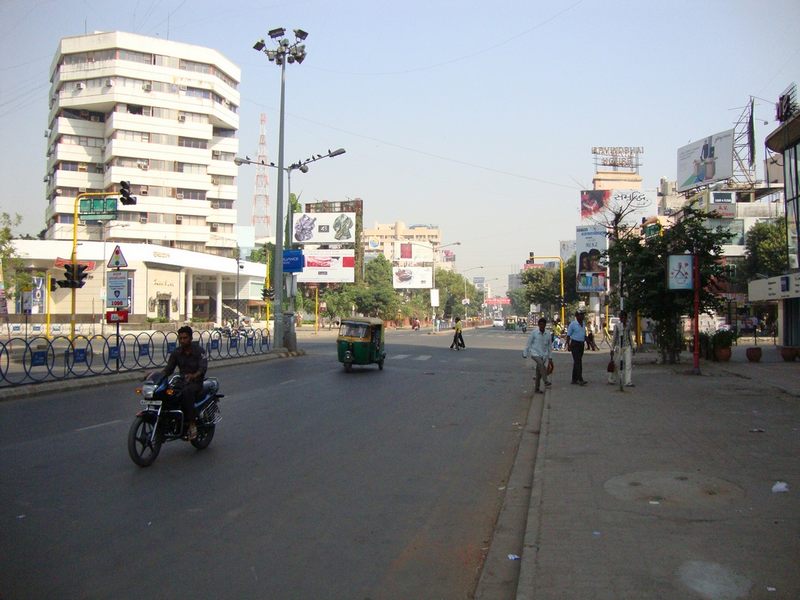
As the city progressed, C.G. road was developed into a modern road after 1985 by Municipal Corporation under the road development scheme. The name of Sheth Chimanlal Girdhardas, a well-known person of the city, is associated with this road. C.G. road is modernised in every respect.
Ring Road widened to 132 feet and known by its width has been developed around the city connecting the areas of AUDA (Ahmedabad Urban Development Authority). These areas are now within the limit of mega city. Ring road starting from Chimanbhai Patel Market at Sarkhej touches Chimanbhai Patel statue, Subhash bridge, Sabarmati.
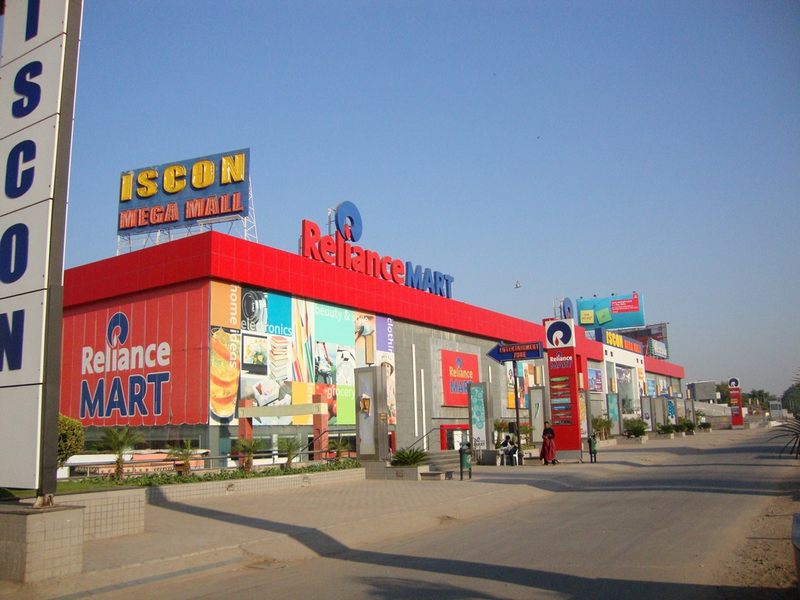
Very recently, Sarkhej-Gandhinagar Highway popularly known as S.G. Road has become happening. It is continuously developing these days. If we start from Sarkhej end, we can first see Karnavati Club. After crossing YMCA, we will come across a row of multiplexes. There is very heavy traffic on the Satellite Cross Roads due to Big Bazar,Iscon Temple and Multiplexes. The road is often so overcrowded that we do not find space to move along Giant shopping mall 'Iscon shopping mall' is located along S.G. Highway. As we pass along the road, we come across Rajpath Club, Gurudwara, Gobind Dham on Thaltej cross road and 'Antim Dham', a crematorium. We can take a turn to Science City from Sola over bridge. If we go straight along this way, we come across Bhagwat Vidhyapith and S.G.V.P.- Swaminarayan Foundation which looks like a palace. Very recently, Balaji temple has come into existence. There are other known temples like Marutidham and Vaishnodevi on the cross roads. Thus, the 10 km long S.G.Road looks pompous.
After the development of 132 feet wide ring road; another Sardar Vallabhbhai Patel ring road is developing. It is like the border of mega City. This ring road of 77 Kms length connects 23 small villages. Sardar Patel Ring Road will be a landmark in the development of the city.

Entertainment Zones


Prev | Next

Kankaria: A Destination of Complete Entertainment

Karikaria lake is beautified and modernised as an entertainment area by Ahmedabad Municipal Corporation under 'Kankaria Lakefront Development Project'
It is pleasant to take a stroll round Kankaria lake.A new attraction - mini train ride "Atal Express" at the cost of 8 crores rupees, is available here. The locomotive engine and four coaches are purchased from Britain. The railway track of four kilometer and Railway station of 70 meter length is made here. Balvatika and Zoo are also modernised. Kankaria is an entertainment spot for. The visitors of all age groups.
Kamla Nehru Zoo of Ahmedabad is famous in India. This zoo started in 21 acres land in the vast hill garden area opposite to Kankaria lake in 1951. Today, it has developed into a full fledged zoo. Rubin David deserves credit for its development.The procreation of some of the animals in this zoo are taken note at the interational level.
Chacha Nehru Balvatika, a children's park is situated in front of full size bust of Pandit Jawaharlal Nehru, opposite to Kankaria lake. Balvatika has a boat house, playroom, mirror, toy house and planetarium. Besides it, there is an amusement and water park called Jaldhara.
One Tree Hill Garden is opposite to Kankaria lake. There was a tree on its peak. When the garden was developed, it became famous as "One Tree Hill" garden. The tombs of the Dutch and the Armenians add beauty to garden.
Matsya Bhavan is an aquarium with modern architechture on the opposite side of the gate of Naginawadi near Kankaria lake. It is named "Matsyabhavan". This aquarium is visited by a great number of visitors.
Tethered Helium Balloon Ride,now first time in India is available at football ground, Kankaria for the public.They can have great experience of viewing the city from 300 feet height.
Prev | Next

Science City

To create awareness about science and technotology and to develop interest and attitude for scientific activities,Science City is a established by Gujarat Government. Scientific principles are made easy for people to understand through entertainment. Science City is spread in 107 hectare at Hebatpur village on Sola- Santej Road. The first phase of its development is about to complete.
IMAX - 3D Theatre is established in Science City for tB7 first time in India. The screen of the theatre is as tall as eighty- storeyed building. The size of the picture screen is 10 times larger than 35 mm projectors.
Science Pavilion: To explain the principles of physics, chemistry, biology etc in a simple way, various designs are made in it.
Pavilion of Space and Communication is raised to explain the principles of space and communication. The visitors get an opportunity to learn about the functions of satellite, mobile phone system, internet and satellite communication.
Many other pavilions and parks such as Energy Life Science, Planetarium, Earth station, LED screen and children's gallery etc. are raised here. There is an amphitheatre with a capacity of 1200 spectators. The biggest Dancing Musical Fountains of India are made with the use of light and sound.
Science City Village Hebatpur, Sola-Santej Road,
Ahmedabad -382481.
Ph.: 55222127/29
Timings: 2.00pm to 11.00pm
Imax 3D: 9898029617, 65220111
Prev | Next

Ahmedabad Gose To Movies

Film is also an important mode of entertainment. Hindi films are more popular than Gujarati films. They have a special attraction among the spectators. in place of traditional theatres, the modem theatre like Drive-in-Cinema and other multiplexes attract the spectators more.
Sunset - Drive-in-Cinema
Among the places of entertainments in Ahmedabad, we can include Drive-in-Cinema because we can enjoy a film along with picnic. The semi-circular ramps to accommodate 703 cars are made on the campus. After parking the car on a ramp, you can fix speaker with the car.
The screen of Drive-in-Cinema is very large. Its length is 63 feet and 142 feet wide.On the opposite side of the screen at a distance, there is a canteen. There is another auditorium for the spectators without cars. About six thousand spectators can enjoy the film at a time. People visit Drive-in-Cinema even in the rainy season. Drive-in-Cinema is a special attraction for the visitors.
Multiplexes
The multiplex like 'City Gold' at Dipali cinema and 'Fun Republic' followed construction of City Pulse of Gandhinagar And then a trend of building multiplexes continued. Gradually, other attractions were added to the multiplex. There are facilities like Video games, Book shops, Food counters and Audio-video shops under the same roof. Now the number of traditional theatres is decreasing and attraction for multiplexes is increasing.

Gujarati Theatre

A class of citizens of Ahmedabad is interested in Gujarati plays. Many organizations like Rang Mandal, IPTA(Indian People Theater Association), Bharat Natyapeeth, Nat Mandal etc. were very active in this field. An actor called Jayshankar Bhojak played the role of 'Sundari', a beautiful young woman character in the play "Saubhagya Sundari" so efficiently that he got the nickname "Sundari" and it got associated with his name forever.
Prev | Next

Clubs and Resorts

The first club of Ahmedabad, namely "Gujarat Club" started on 18th March 1888, situated opposite to Congress House in Lal Darwaja area. The first meeting between Sardar Vallabhbhai Patel and Gandhiji took place here. Ahmedabad Gymkhana started in 1895. The trend of club culture started in Ahmedabad with the start of Sports Club in 1965. This Club has given well- known billiard players like Geet Shethi and Rupesh Shah. Rajpath Club was established in 1976.The most beautiful club of Ahmedabad, Karnavati Club is functioning since 1994. This is perhaps, the biggest Club of India. The Rifle club has very old establishment with different aim and objectives. Also, here are many known resorts in the city.

Art And Culture


Gujarati literary culture

Let's have a bird's eye view of the historical facts about Gujarati literary culture. In the time of Muhammad Begda, Lahuraj of Amadupura wrote a book titled 'Vimal Prabhandh' and Saint Dadu Dayal wrote a book titled 'Sunder Vilas' in the time of Akbar. Vallabh Bhatt (1680-1780)composed Garba, Garbi and Aarti. The mediaeval Gujarati literature was enriched by Akho and Shamal. Very recently, a full size bronze image of Akho is placed near his residence in Khadia.
Poet Dalpatram (1820-1898) worked as the editor of 'Buddhiprakash' the publication of which still exists. A full size bronze image in sitting posture is placed near his residence at Lambeshwar Pol, Relief road.
The highest award for literary creation 'Gyanpeeth' is bagged by three literary artists of Ahmedabad Umashankar Joshi (1911-1988), Pannalal Patel (1912-1989) and Rajendra Shah (1913-2010). The Central Government has honoured Kumarpal Desai and Bholabhai Patel with 'Padmashree' award.

Painting

The mural painting on the main entrance of Ahmedabad railway station created by Shiv Pandya and Shanti Shah catches anyone's attention. We can watch Jain Pothi paintings in the museum of Lalbhai Dalpatbhai Institute and B.J.Vidyabhavan. The best specimens of 'Pichhwai' of Pushti sect of Vaishnavism are found in Sarabhai Foundation. During Mughal period, an artist of Ahmedabad, Abul Hassan Vadifzana had drawn the picture of Jahangir' s coronation on the title page of his autobiography 'Jahangirnama'. Shri Sahajanand Swami had patronized Swaminarayan painting style and encouraged'Chhap Chitra Puja' system. The first painter of this tradition, Shri Narayanbhai Suthar prepared a profile painting of Sahajanand Swami as Shri Hari.

The advent of painting in Ahmedabad

Ravishankar Raval made Ahmedabad his field of work and he really worked like 'Kalaguru'. Others among the well-known painters are - Chhaganlal Jadav, Kanubhai Desai, Rasiklal Parikh and Shantilal Shah.
Sheth C.N.Kala Maha-Vidyalay started in the year 1951 and Rasiklal Parikh was its first principal. Many senior artists contributed to the field substantially and earned fame. Many contemporary artists came forward and developed different styles. When Lalitkala Academy was established in Gujarat, the painters and painting were encouraged greatly. So, many artists got awards of honour .

Sculpture

The Indian sculpture has emerged and developed from the artist's spiritual realization and thinking. The Swaminarayan temples, Hathisingh's temples and other temples are the best places depicting that sculpture.
The world famous sculptor, Kantibhai Patel, who had prepared the sculpture of Gandhiji placed at Income Tax cross roads at the end of Gandhi bridge, has his studio in Ahmedabad. The images of Sardar Vallabhbhai Patel and Induchacha prepared by him are also placed in the public places in Ahmedabad.The sculptor, who prepared the eighteen and a half feet tall image of Queen Laxmibai is Jasuben Shilpi of Ahmedabad. Ratilal Kansodaria is contributing a lot in the field of modern sculpture. The images of Akho and poet Dalpatram prepared by him are noteworthy.

Dance

The folk dance of Gujarat like Garba, Garbi, Raas, Rasado, Hudo and Tippani as well as the Adivasi folk dances play major part during religious and social festivals.
Mrinalini Sarabhai established 'Darpana Academy for Performing Arts' in 1945. At present, there are many big and small dancing institutes/classes imparting training in dancing. Mrinalini Sarabhai has been awarded 'Padma Bhusan' and Kumudini Lakhia and Mallika Sarabhai have been awarded 'Padmashri' for their contribution in the field of classical dance. Joravarsinh Jadav is active in the work of preserving our cultural heritage of "folk dances".

Music

Bhakti sangeet (singing of devotional songs of various sects) and folk music have contributed very well in the cultural growth of Ahmedabad. In the year 1922, Gujarat Vidyapith started courses for music under Narayan Moreshwar Khare. 'Gandharva Mahavidyalay' and 'Bhartiya Sangeet Mahavidyalay' are very old institutes for teaching music which are functioning even today.
The musical programmes began to be relayed on the radio after the radio-station started functioning in 1949.Avinash Vyas has played a vital role in making the light music popular. The contribution of Kshemu Divetiya, Rasiklal Bhojak, Bhailal Barot, Dilip Dholakia, Rasbihari Desai and Gaurang Vyas is noteworthy in the field.There are several big and small music institutions in the city.

`Saptak` Music Festival - Jan. 1 to 12

The famous institution of classical music 'Saptak School of Music' started in the year 1981, by the famous tabla player, Nandan Mehta, classical singer Rupande Shah and sitarist Manju Mehta. It organizes 'Saptak Music Festival' at Kashiram Hall from January 1st to 12th every year. The singers of classical music from all over the country are invited to participate in it. The tradition of Saptak has made people crazy after music. It is the largest Indian classical cocert in the worlds.

Folk Arts

The folk life of Gujarat is rich with art and culture.In absence of the mediums of entertainments like television, films etc. people used to get entertainment from Fairs,Bhavai, Ramleela, Turis, Bhand, Bahurupees, Puppet Shows, Vadi, Snakecharmers etc. Raas-Garba, Kutchchhi Ghodi, Fencing, Dancing etc. also provide entertainment to the people.

Handicrafts

The handicrafts of Gujarat have earned reputation even in the foreign countries.Some housewives are interested in embroidery. Chakada, Toran and Chandarva prepared with patchwork are still popular.
Some artisans living near Shankar Bhuvan and at Mirzapur are known for their art of textile block painting called 'Mata-ni-Pachhedi'. A roadside market near Law Garden is famous for chania-choli and rural style jewellery. It remains over crowded duringNavratri festival. A big settlement of Ganesh idol makers is at Gulbai Tekra.
The use of ethnic and antique things catches our attention. People display bronze lamp stands, utensils, images etc. as decorative pieces in their houses. We find utensils and furniture with fine engravings and carvings. Gurjari Emporium, run by the Government of Gujarat is famous for selling the specimens of handicraft.

Photography

If we trace the history of photography in Ahmedabad, we learn that Colonel Biggs R.A. of East India Company had photographed the architectural structures of Ahmedabad in 1853, and his album containing 120 photographs was published in 1860.
After that, Shamsuddin Lukmanji started photography in Ahmedabad in 1870. The first city photo studio called Bhavnagari Studio was opened in 1898. A photo studio named 'Kanetkar and Co.' started in 1917. Photographer Janardan Dighe covered Congress Convention of 1921 held in the city through his lens. In 1930, Balwant Bhatt covered Gandhiji's Dandi March with his still camera and Ramniklal Tolat had screened the event in an eight hundred feet long film reel and immortalized the important event of Dandi March.
Pranlal Patel photographed the events of centenary celebrations of Ahmedabad Municipality in 1935 and also of the important events during the 'Quit ndia' movement of 1942. Jagan Mehta also photographed the 'Peace March' led by Gandhiji during communal riots in Noakhali.
French photographer, Henry Cartier Bresson, the founder of the world famous institution of photography called 'Magnum' had photographed Ahmedabad. an 1955, an exhibition of photography entitled as 'A Family Man' was arranged in Ahmedabad in which photographs of Edward Stich were displayed.
Ravishankar Raval started 'Kumar Camera Club' to provide training in photography in 1925 and later on it was converted into 'Niharika Camera Club'. Again in 1981, 'Camera Club of Karnavati' came into existence.

Shinning Stars of Sports

The contribution of Jasu Patel, Dipak Shodhan, Dhiraj Parsana and Parthiv Patel of Ahmedabad is noteworthy in Indian cricket. We cannot forget Geet Sethi as a world champion of Billiard and Snooker and Rupesh Shah as a talented national sportsman. In the field of international chess, Tejas Bakare is a 'Grand Master'. In the field of international hockey, Dipika Murti's achievement as goalkeeper cannot be ignored.

Architecture

Before visiting the well known architectures of Ahmedabad, let us have primary knowledge about architecture. The period of Karnadev Solanki was rich in Hindu and Jain temples. In the beginning of the 15th century, Ahmed Shah established Ahmedabad and started raisirig new architectural structures.
The architectural structures of Ahmedabad are externally Islamic but their foundation lays on Hindu and Jain tradition. As a result, the contemporary architecture appears different from other Islamic architecture because of its artistic design. We also find in it, those things which were usually neglected. Such a mixed architecture is called Indo-Sarasenic architecture.
There are many peculiarities in the architectural structures of mosques.
  • For getting fresh air and light in the mosques, the central place is raised and a dome is constructed.
  • Beautiful artistic jalis are observed in many mosques. e.g. Sidi Saiyed mosque.
  • Attractive engraving in the balconies and recesses of the wall is unique.
  • The construction of the minarets of mosques and their workmanship are remarkable. The rocking minarets of Ahmedabad are a wonder.
  • The Interi type architecture is remarkable e.g. Azam-Muaz and Dariyakhan Raja.
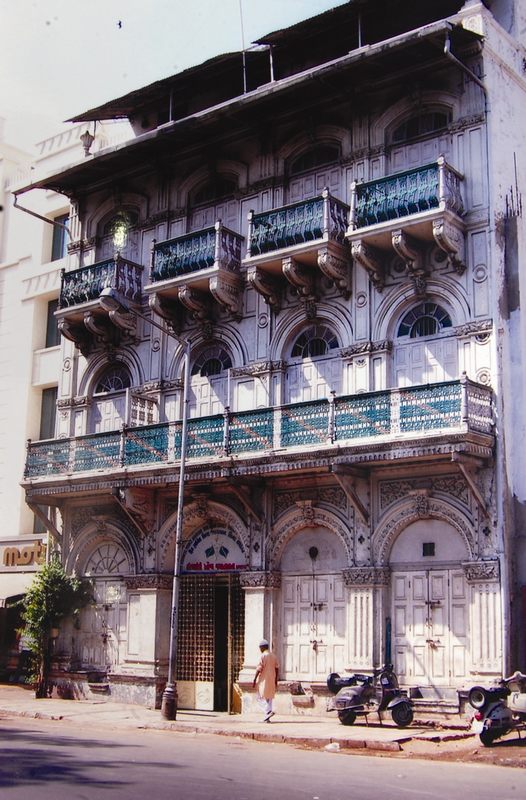
The residential structures built during the Mughal period have the arch of the Mughal style. Such an arch is seen in the palace of Azamkhan. With a few alterations, an Amdavadi arch was made. It is narrow and tall. It has the shape of a Pipal Leaf Such an arch is seen in many homes these days. The structures like Motishahi Palace, Azamkhan's Palace and Bhadrakali temple were built during the Mughal period.
In the Maratha period, Gaekwad's Haveli was built. Among the Hindu religious places, the construction of Bhimnath Mahadev temple is worth mentioning.
During the British period, many Shiv temples, Vaishnav Havelis, Swaminarayan temples, Hathisingh's temples and Jain temples of Zaveriwad were built. The special Vastushastra, the science of architecture is taken into consideration while constructing temples. The identification marks, for recognizing the images of Jain Tirthankaras are placed in the middle of the pedestal.
Ahmedabad Municipal Corporation has constructed crematoriums in the areas like Saptarshi, Dudheshwar, behind V.S. Hospital ,and Vadaj. The crematorium built at Thaltej Cross Road on S.G. Highway named 'Antimdham' is beautiful. The image of Lord Shiv placed there is attractive and it catches attention of passers by as well as of the visitors.
The place where the Parsi's dead bodies are laid down is known as 'Dakhma', the tower of silence. It is a tradition of Parsis that the dead body is placed into Dakhma for the vultures to devour them. The construction of Dakhma is done according to the architectural design suggested in Zorastrianism. We find beautiful carving on the stones placed on the protestant christian tombs.
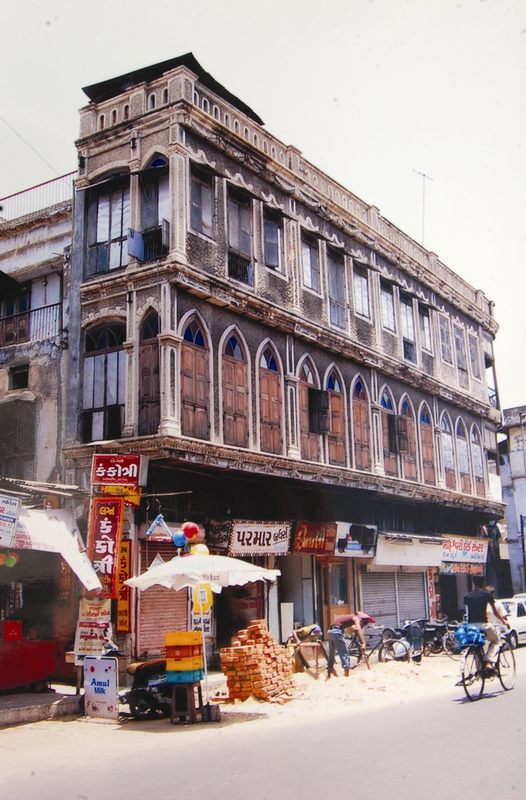
It is advisable to visit the pols of the old walled city to know the architectural design of the residential places of the city. Some constructions are built for public use, for example, school, hospitals, public hall, cinema hall,pond etc.